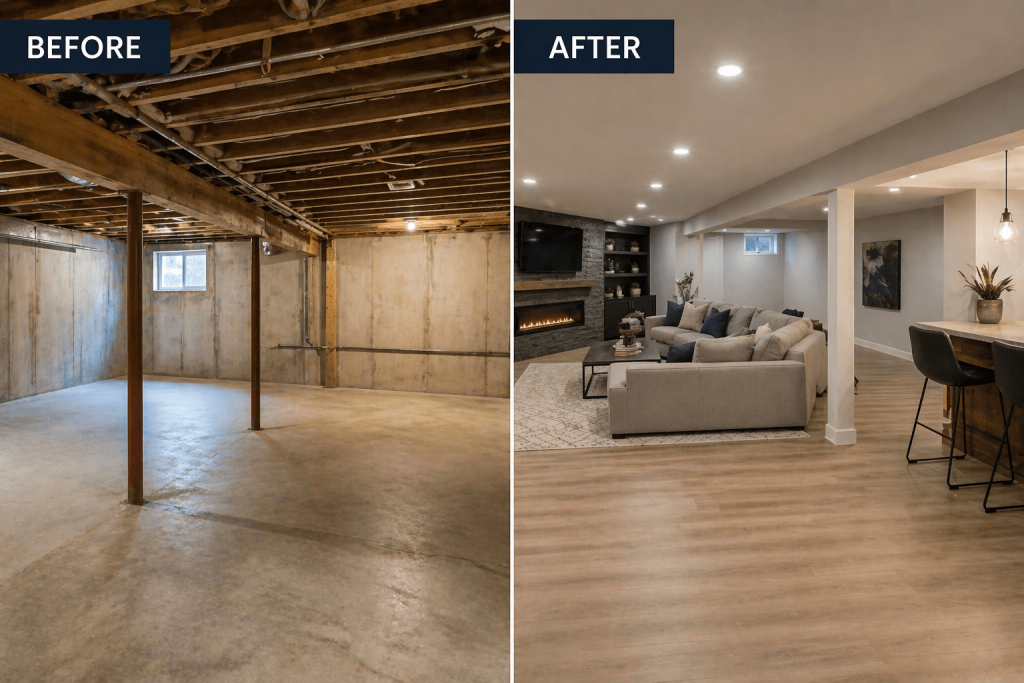
Quick Answer: The most popular basement remodel financing options include HELOCs (starting around 7% APR), home equity loans (6 to 9% fixed), personal loans ($15,000 to $100,000), cash-out refinancing, and FHA 203(k) rehab loans. For a typical $50,000 to $100,000 basement remodel, homeowners in Darnestown, MD and Garrett Park, MD with strong home equity will usually get the best rates through a HELOC or home equity loan. This article breaks down every financing option with current rate ranges, pros, cons, and which one makes the most sense based on your financial situation.
Why Basement Remodel Financing Options Matter More Than You Think
Here’s something we hear all the time: “I want to finish my basement, but I’m not sure how to pay for it.” And honestly, that’s one of the smartest questions you can ask before starting a project like this. A basement remodel in Maryland typically runs anywhere from $25,000 for a basic finish to $150,000 or more for a high-end buildout with a bathroom, kitchenette, and home theater. That’s a big range, and how you pay for it can make as much of a difference to your bottom line as the materials you choose.
Even if you have the cash sitting in savings, pulling $80,000 out of your accounts isn’t always the best financial move. Depending on your equity, interest rates, and tax situation, financing can actually save you money in the long run. The key is understanding your basement remodel financing options so you can pick the one that fits your life, not just your project.

Basement Remodel Financing Options at a Glance
Before we dig into each option, here’s a quick snapshot of the five most common ways homeowners in the greater Maryland area fund their basement remodels:
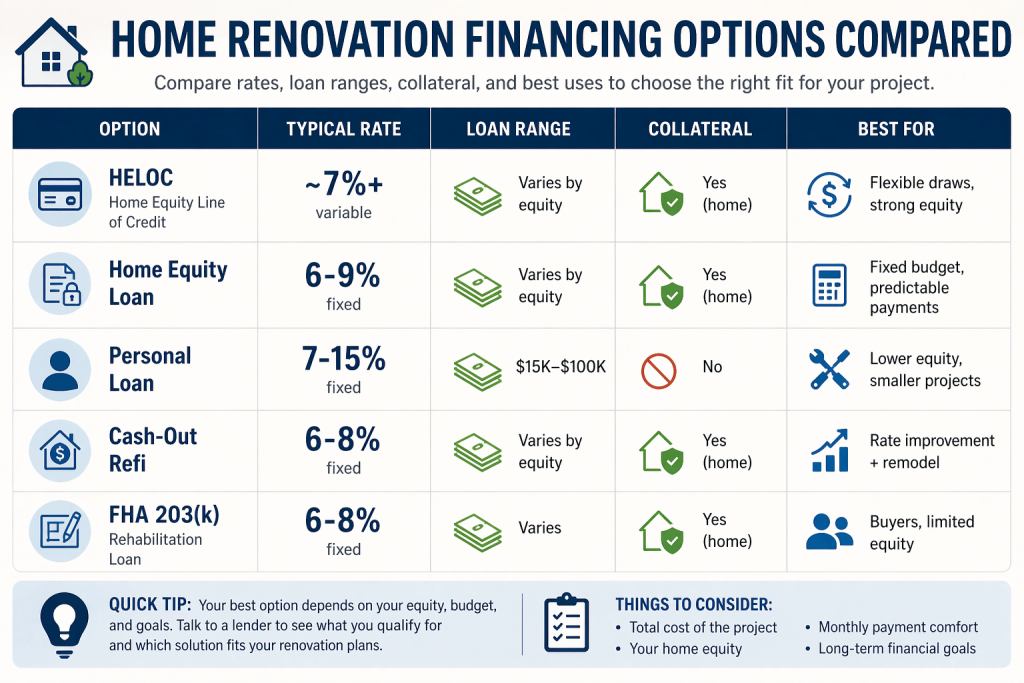
Now let’s break each one down so you can see which fits your situation best.
Option 1: Home Equity Line of Credit (HELOC)
A HELOC is the most popular financing choice we see among homeowners tackling basement projects, especially in communities like Darnestown, MD where home values (and therefore equity) tend to be strong. A HELOC works like a credit card secured by your home. You get approved for a maximum amount, and you draw from it as needed during a “draw period” (usually 5 to 10 years). You only pay interest on what you actually use.
Current HELOC rates start around 7% APR, though your actual rate depends on your credit score, equity position, and lender. The big advantage here is flexibility. Basement remodels are notorious for surprises (old water damage behind walls, electrical upgrades you didn’t plan for), and with a HELOC you can borrow a little extra if you need it without going through a whole new application.
The downside? HELOC rates are variable. If rates climb, your monthly payment goes up with them. That’s fine if you plan to pay it off quickly, but it’s something to factor in if your remodel is on the larger end.
Option 2: Home Equity Loan
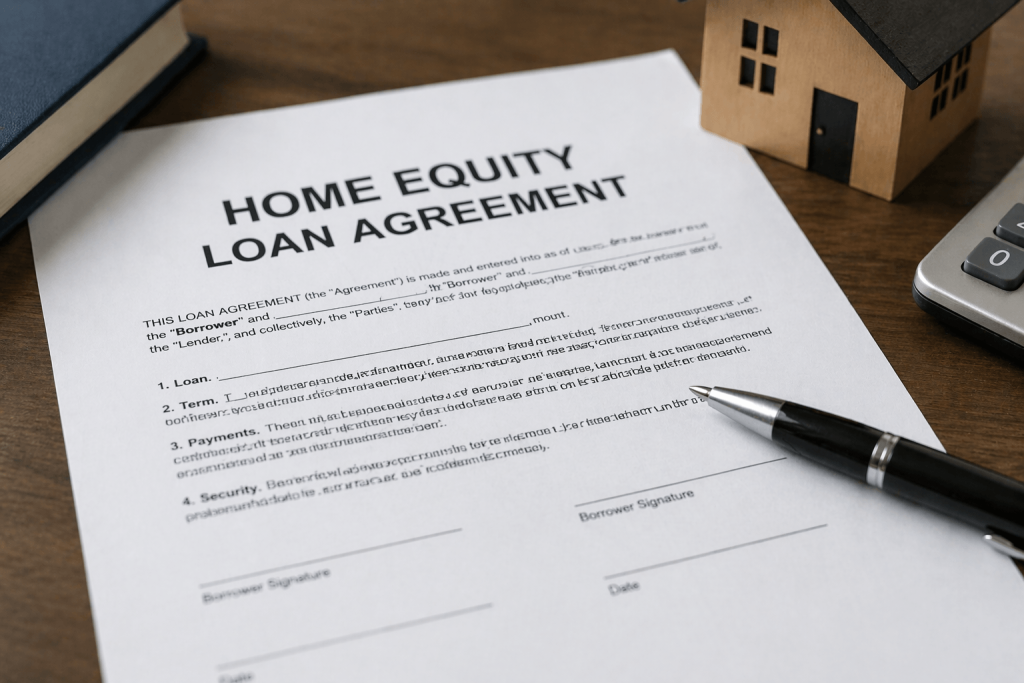
If the variable rate on a HELOC makes you uneasy, a home equity loan might be more your speed. You borrow a lump sum at a fixed interest rate (currently in the 6 to 9% range) and pay it back over a set term, usually 5 to 30 years. Your payment stays the same every month, which makes budgeting predictable.
We’ve seen this work really well for homeowners who have a firm budget and a detailed scope of work. If your contractor has given you a solid estimate of $65,000 for a full basement buildout, a home equity loan lets you borrow exactly that amount and know your costs from day one.
One thing to keep in mind: closing costs. Home equity loans often come with fees of 2 to 5% of the loan amount. On a $75,000 loan, that could be $1,500 to $3,750 in fees you’ll want to account for in your overall budget.
Option 3: Personal Loans for Basement Remodel Financing
Personal loans are unsecured, meaning your home isn’t used as collateral. That’s reassuring for some homeowners, and it also means the approval process is usually faster (sometimes just a few days). Loan amounts typically range from $15,000 to $100,000 with fixed rates between 7 and 15%, depending on your credit.
The catch is that rates are almost always higher than equity-based options, and repayment terms are shorter (usually 2 to 7 years). That can mean bigger monthly payments. Personal loans tend to be the best fit for smaller basement projects under $50,000 or for homeowners who don’t have enough equity to qualify for a HELOC or home equity loan.
Option 4: Cash-Out Refinance
With a cash-out refinance, you replace your existing mortgage with a new, larger one and pocket the difference. For example, if you owe $300,000 on a home worth $600,000, you might refinance for $375,000 and use the extra $75,000 for your basement remodel.
This can be a great option if today’s mortgage rates are lower than your current rate, because you’d be reducing your overall interest cost while also funding your project. But if your current mortgage rate is already low, refinancing at a higher rate could cost you more over the life of the loan than a HELOC or home equity loan would. Run the numbers carefully (or have a mortgage broker run them for you) before going this route.
Option 5: FHA 203(k) Rehab Loans
FHA 203(k) loans are government-backed loans that let you roll renovation costs into your mortgage. They come in two flavors: the Standard 203(k) for projects over $35,000 (which covers basement buildouts) and the Limited 203(k) for projects under $35,000. These loans require a HUD-approved contractor and more paperwork, but they offer competitive rates and lower down payment requirements.
This option is especially helpful if you’re buying a home that needs work or if your equity is limited. Homeowners in Garrett Park, MD who are purchasing older homes and planning to finish the basement right away often find 203(k) loans to be a smart way to bundle everything into one loan.
Contractor Financing and Payment Plans
Some contractors offer in-house financing or partner with lending companies to provide payment plans. This can be convenient since you handle everything in one place. But we’d encourage you to read the fine print carefully. Promotional rates like “0% for 12 months” can jump to 18 to 25% after the promo period, and deferred interest means you could owe back interest on the full amount if you don’t pay it off in time.
Contractor financing isn’t inherently bad. It just requires the same comparison shopping you’d do with any other loan. Get the APR, term, and total cost in writing, and compare it to what a bank or credit union would offer.
How to Choose the Right Basement Remodel Financing Option for You
Choosing the right financing really comes down to four factors: how much equity you have, your credit score, how much you need to borrow, and how quickly you want to pay it off.
If you have strong equity and good credit, a HELOC or home equity loan will almost always give you the lowest rate. If you want fixed payments and a predictable budget, go with the home equity loan. If you want flexibility and plan to pay it off within a few years, the HELOC is probably your best bet.
If equity is limited or you’d rather not use your home as collateral, a personal loan gets you funded fast with less risk. And if you’re buying a fixer-upper with an unfinished basement, the FHA 203(k) is worth exploring.
Common Mistakes Homeowners Make When Financing a Basement Remodel
After working on basement projects across Maryland for years, we’ve seen a few financing mistakes come up again and again. The most common one is underborrowing. Homeowners try to keep the loan as small as possible, then run out of money mid-project and end up with an unfinished basement and a loan payment on something they can’t fully use. It’s almost always better to borrow 10 to 15% more than your estimate to cover unexpected costs like waterproofing issues or electrical upgrades.
Another mistake is not shopping around for rates. The difference between 7% and 9% on a $75,000 loan adds up to thousands of dollars over the life of the loan. Get quotes from at least three lenders. And finally, don’t ignore the closing costs and fees. A loan with a slightly higher rate but no origination fee might actually cost you less overall than the “lowest rate” option.
Final Thoughts on Basement Remodel Financing Options
There’s no single “best” way to finance a basement remodel. The right basement remodel financing option depends on your equity, your credit, and how you like to manage debt. What matters most is that you take the time to compare your choices, understand the true cost of each option (not just the monthly payment), and borrow enough to finish the project right the first time.
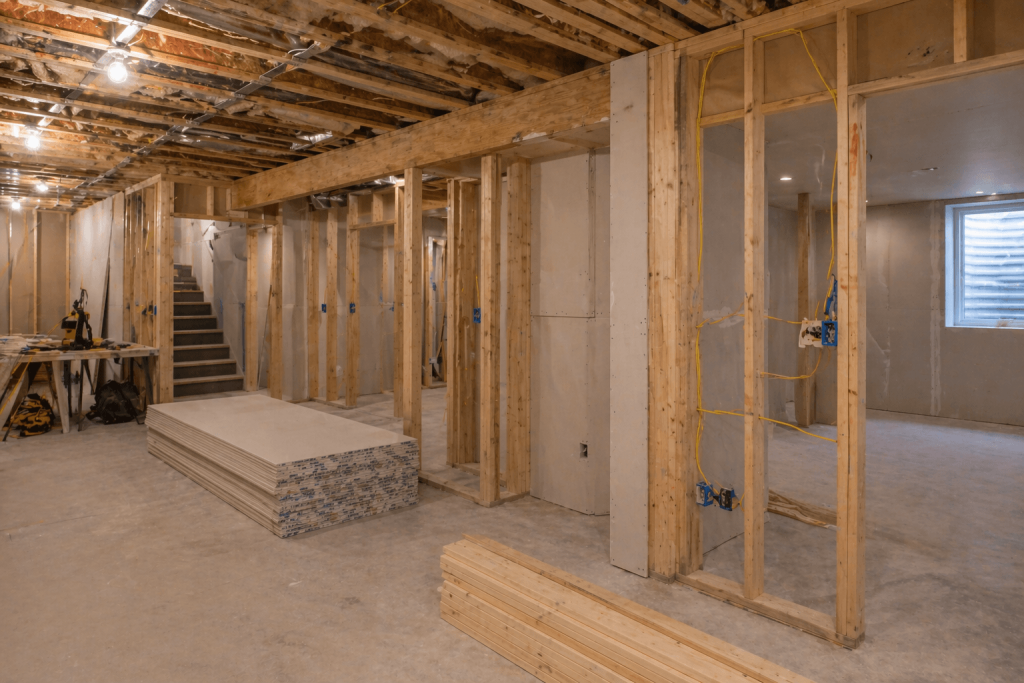
A finished basement adds real living space, real value to your home, and real enjoyment for your family. Whether you’re in Darnestown, Garrett Park, or anywhere else in the greater Maryland area, the investment is almost always worth it. Just make sure the financing works as hard for you as the remodel itself.